I’ve been playing around with watercolor for a few months now, but I’ve never taken the time to try to understand how this medium really works. While it seems simple on the surface, let me assure you, watercolor is not easy. Yes, there are only four main components: paint, water, brushes, and paper. But the variety of ways these four can interact is endlessly complex and very difficult as a beginner to undertake.
Fortunately, I have Gordon MacKenzie’s The Complete Watercolorist’s Essential Notebook to help guide me. Early in the book he recommends getting to know one’s brushes through simple exercises. This week, I undertook this exploration with the three different brush types I’ve purchased so far: a round, a flat, and a script. While exploring the different shapes each brush offers, I was also trying to understand better how the water and paint interact on the brush and on the paper.

The round brush is great for making lines that vary from thin to thick and is very versatile. For my practice sheet I tried varying the amount of water I placed on the paper and the amount of water and paint I held on my brush. Dry paper with a paint-heavy brush allows for super intense lines but doesn’t have much flow. Putting water on the paper and then painting over it with a brush that isn’t super wet leads to a very jagged shape (see the spermy-looking thing in the bottom right corner). Wet paper with a wet brush allows for the most flow of paint over the canvas (see bottom left corner). Dry paper with a very water-heavy brush leads to what’s known as a water spot (see top left corner).

The flat brush is a go-to for backgrounds and thick flatter shapes. I played mostly with different amounts of water on the brush vs. the paper as I’m still trying to figure out how to make backgrounds and skies look more natural. Super wet paper and a water heavy brush makes for some really interesting shapes but also leaves unnatural looking dark edges. A more tempered amount of wetness on the paper and brush leads to a very even distribution of paint. The less water on the paper and brush obviously the harder it is to get paint to flow on the paper.
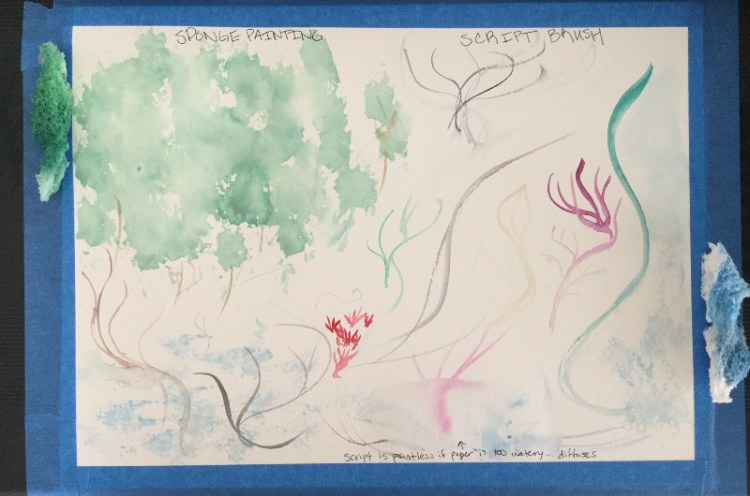
The script brush is amazing for creating fine flowing lines and is super fun to paint with. I tried using the script brush on an area of the paper that I had wetted and it completely diffused the lines, defeating the whole purpose of the brush. So, I know this one is best used on a mostly dry surface. I also played around with cutting up some sponges and sponging paint on the paper. Creates some great shapes, and would work well for forests and clouds.
What I’ve learned so far in my explorations is that watercolor is not an obedient medium. I can’t just put paint on a brush and water on the paper and expect it to do what I want. There is a free-flowing quality that just can’t be overcome by will or covered up by mashing on more paint. As MacKenzie says “Try to push this medium around, and it quickly loses its charm, its transparent radiance and its life.”
As a bonus for getting this far with me, here’s my super fancy painting workspace in our tiny apartment (yes, it is a counter):

 Compulsive Creation